Showing posts with label teaching. Show all posts

Wednesday, February 16, 2011

It's Good for Well-Being!

Last week, I assigned my class a speaking presentation. Of course, they were horrified. ("You mean, I have to get up in front of my peers and talk about something for three to five minutes in English?! And, oh, God, you'll be listening to my enunciation? And I need to have correct grammar?? And organization?? And transitions???!!!") This is generally the point where their heads explode. But I don't mind. After all, I am ostensibly training them for life in an (Western) English-speaking university, where giving presentations is an important part of many classes, especially in business and commerce, the areas in which many of my students plan on majoring.

So, yes, presentations are an ugly, yet compulsory part of my class.

In the past, the quality of my students' presentations has been entirely underwhelming. In past semesters, I've assigned a general topic, such as "my favourite childhood memory" or "an object that is special to me", but these get really old really fast. So this term, I tried something new. I told them they could choose their topic, as long as it was persuasive; I called it the "persuasion presentation." Of course, when I first introduced it to them, they were lost. Then we started brainstorming where/when/how people try to convince others of something. We thought of advertisements, politicians, religion,  and education, among other things. The point was to show them that persuasion was everywhere. I then modeled my own persuasive presentation, which was "why you should go for a polar bear swim." I organized it with a clear introduction, body, and conclusion. My main points were that you should go for a polar bear dip because it was good for your health, and because it was an integral part of Canadian culture. (BS, yes, but it didn't have to be necessarily true, as long as it was well-organized and fit the objectives).

Well, after my model presentation, one of my students, R, decided abruptly that he wanted to change his topic to be fictional, like mine. Now, this student doesn't make waves in class. He's one of my two Koreans, quiet, respectful, and motivated. He's also a good five years older than most of the other students, which gives him a maturity that some of the others lack. When I asked him what he wanted to do for a topic, he proudly answered, with a big grin, "why you should drink your own pee!!!" My response was along the lines of "double-yew tee eff," but he was persistent, even the next day, after I told him to go home and think about it. (All the other students were set on doing "real" topics, like why studying in a western university is better, why playing sports everyday is good, why renting a house is better than homestay, and even why you should eat tuna, etc...). But no, R wanted to talk about the merits of drinking your own pee. So, I relented.

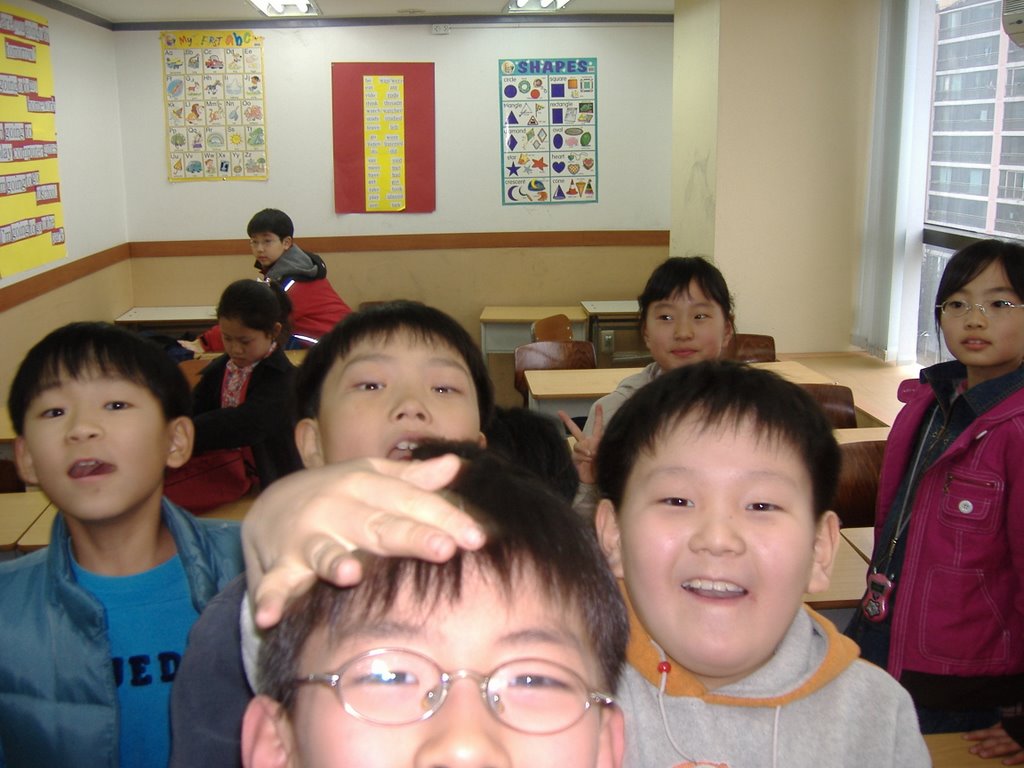
On the day of the presentation, he set up his image (only two students took my advice and included an image with their presentations; the other student's image was of a can of tuna), and proceeded to launch into this amazingly well-organized, well-supported presentation, full of details, transitions, lecture language, etc... in short, everything I had told my students I expected of them. His image was hilarious, and I have included it here. His main points were as follows, and they correspond to his image accordingly: new research in the field of urine therapy, nutritional information, health benefits, and last, how it increases your lifespan. ("Do you know how old these people are? They're sixty years old!!! Drinking your pee can make you live to 120!"). It was especially funny because he appears so normal and straight-laced. Verdict: best student presentation ever!

(Later, when I told some of my co-workers about it, one said, "Hey, did you know that in Mongolia, drinking your mother's pee is believed to have amazing health benefits?")

Tuesday, January 25, 2011

Grammar Rules!

I make no qualms to hide the fact that I think English grammar is really interesting, and I think my enthusiasm for it comes across in my teaching. (In fact, I'm the grammar teacher for my level at work... that is, I teach grammar to my own class in addition to two other classes).

Before I taught in Korea, and even after teaching there, I had no idea how to explain anything in regards to grammar. I had no idea about verb tenses, parts of speech, or any formal terms to explain the process and the practice of grammar. After I completed my TESL certification at the U of S, however, I realized halfway through my grammar and phonology class that I am actually one of those people who really get enthused about the underlying structures of the language.

I think that anyone who has struggled with learning a second language has probably sat through innumerable grammar classes with a teacher droning on about irregular verbs or some kind of impossible tense, but I take a different approach. I present the grammar structure we're studying, and have them take notes (so they can also practice their listening/note-taking skills), then I make them explain to each other (in partners) the concept I just taught them. I will then usually do a quick drill or worksheet to reinforce the concept before doing a class activity (role-play, discussion, game, etc) that requires more thought and creativity with the grammatical structure than a simple drill or worksheet.

When I first started teaching at my university, I had very little experience teaching grammar and not a lot of knowledge as to how to teach it. However, my amazing co-worker John, (also a former ESL teacher in Korea), created a handout for a presentation he did at a conference a while back which clearly explains all the verb tenses. Check it out here! (It won't make you tense, I promise).

Sunday, January 16, 2011

A Continuation of "How To's"

It is clear from my Internet surfing for the past hour (hours...?) that I am indeed procrastinating. I seem to have a case of multi-procrastinationitis, really, which is two or more times more inefficient than just single-task procrastination. It's like multi-tasking, only the opposite, because you can get twice as little done in just as much time.

Anyway, I've started a new term at the University of the Coldest Place on Earth, and as a general topic for a speaking presentation this term, I was thinking about giving them a "how to" presentation, whereby they have to instruct the rest of the class how to do something.

I'm not too picky. I though they could easily be able to do something like this.

Monday, January 10, 2011

How to Swear in Englishee

"Little children and pregnant women should not watch."


I love the objective of this video. He is teaching Koreans how to swear in English, not because he wants them to swear, but so they can understand what the foreigners (insert scary Jaws music here) say when they are swearing at Koreans. Personally, I think he should have included a bit more of an opportunity for role-playing to practice the new vocabulary in an appropriate context. Also, pronunciation needs to be stressed, so that "fuck" doesn't end up sounding like necessary equipment for a hockey game.

Tuesday, December 21, 2010

Say What?

One important aspect of English-language education that often gets overlooked is, I believe, pronunciation. I have met many students of English who are, for the most part, quite fluent, even able to get through a master's program in an English-speaking university, but who constantly struggle to make themselves understood to native-English speakers. This is true not only of students, but of professors in universities, as well. Not only is it frustrating for both speaker and listener, but, it may also make the non-native speakers question their language abilities and doubt themselves.

I think the problem is easily solved, but it requires explicit instruction. The vast majority of students are not able to pick up the correct pronunciation by simply listening and emulating a native speaker. In addition, in all languages, there are specific aspects of an ESL student's first language that cause difficulty when learning English, and these must be acknowledged and understood.
Here are a few common pronunciation problems for Korean speakers when they are learning English, because I'm too lazy to write them all out myself.


One of the most important differences between English and many languages is that it is a stress-timed language, as opposed to a syllable-timed language (such as French and Japanese). Syllable-timed languages give equal weight to each syllable in a word, whereas English (and German, Russian, and Mandarin) are stressed-timed languages, in which certain syllables and certain content words (such as nouns, verbs, adjectives and adverbs) must be stressed. Alongside the stress, of course, must be taught the unstress (the schwa - the most common sound in the English language). English teachers need to focus on word and sentence stress/unstress patterns (which I am not going to define or describe further, since voluminous amounts of information exist already on the topic, and there is no need for me to repeat it here). Just know that as a teacher, you need to be aware of it, and of the addition interference or difficulties that your students may have based on their first language.

Teaching American English Pronunciation, by Peter Avery and Susan Erlich, is a book I would not teach without.

And here are some techniques for teaching pronunciation.


Here's yet another good site to get you started.

Saturday, December 18, 2010

Top 50 Blogs for Teaching Abroad

Well, somehow or another, we made it to a list of Top 50 Teaching Abroad blogs. Some of the blogs listed are particularly worthy, so check them out!

Thursday, December 9, 2010

It's that time of the month...

...when I feel about ready to explode from stress. For the past week and a half, we've had Hanukkah and Roo's third birthday, both of which have necessitated lots of visiting with extended family (...), and my "Lady Grammar" performance, which went over well at the Language Centre's final party.

Now it's time to gear up for my mother's hasty second marriage. Well, not hasty in that she and my father have been happily divorced since 2000 (for a sum total of 20 years if you count their initial, therapy-inducing ten). I mean hasty in the sense that she and her husband-to-be, Helmut, (yes, that is his name!) have been courting since July of this year. Although they used to know each other in the early 1980s (they used to be couples friends during the drop-off years of disintegrating first marriages), and although there was some "attraction" there, nothing happened, then divorce, then his subsequent marriage, etc, etc.... Anyway, she's blissfully in love, and I'm happy for her.

I had thought that Celine Dion might be involved in this celebration, and by gum, she be! Mom will surprise Helmut with a song ("Then You Looked at Me"), which she'll sing and I'll play on acoustic guitar. It's a pretty huge step for her to actually stand in front of people to perform in this way, so I think it's pretty cool. I don't even care that it's Celine Dion! Bo and Roo and I have also been practicing a song that they'll be singing, and which I'll play, "Hinneh ma Tov." That's exactly how we sound. And look.

Sunday, November 28, 2010

Same-Sex Marriage Debate in Class

For the past 2 years, I have taught English at a Canadian university. Over this time, I have taught hundreds of students, most of whom are Chinese. Among them, though, there have also been a few dozen from other countries, mostly from Saudi Arabia, but also a few from Latin America, Korea, Japan, and a few from Iraq (via Jordan). Now, I figure, simply because of the law of averages, I have had a few students who are gay.

One activity I do most every term in my class (after a few weeks, so that we have had time to develop a good rapport with each other) is a same-sex marriage "debate." I do this for a few reasons:
1) Same-sex marriage is legal in Canada, and people from other countries who are living here should know our stand on it
2) Some of the students I've had are undoubtedly gay, but are generally from countries that either a) don't acknowledge homosexuality as even existing, or b) don't acknowledge homosexuality as even existing, but if it does, it is a criminal offense punishable by imprisonment or death (mainly the "Koran Corset" countries, as opposed to the Bible Belt - although homosexuality is certainly most alive and kicking in Saudi Arabia).
3) It's good for students to cultivate empathy for others' points of view that they don't necessarily share, and finally,
4) it allows students to practice expressions for stating opinions and disagreeing.

So how do I do this activity? First, I tell the students a story about my best and oldest friend, whose wedding I attended a few years ago. The kicker at the end of the story is that instead of a bride and a groom, the wedding featured a bride and a bride. I let the news sink in for a moment, and observe the reactions, which range from "Wow, cool!," to general ambivalence, to disgust. Then I ask them for their opinions - for or against. Almost without fail, it seems, the students schooled in either Christianity (Korean, Latin American) and Islam are wholeheartedly opposed to the idea. The Chinese, (and Japanese, to a lesser extent) generally range from enthusiastic support to overall ambivalence. (In my class of 14 Chinese students this term, for instance, I had only one student opposed to the idea, and he is nearly 10 years older than the rest of the class - I don't know if age has anything to do with it at all, but I think a little while ago, there was a celebrity drag queen in China that drew some attention to the issue). Then, based on their opinions, I divide them into 2 equal groups (this works better is there is about a 50/50 split of opinion, but usually, because of the Chinese influence, it ends up being about 80% in favour of the idea). The students who are opposed are in one group, with the pro-same-sex group in another. I give them some vocabulary (homosexual, straight, bisexual, gay, lesbian) and then I then tell them they are going to have a debate... but they have to argue in favour of the opinion they don't actually have. So, in groups, they brainstorm reasons to support their arguments. Overhearing the brainstorming session the other day was particularly charming - this from a student struggling to find reasons to oppose it:

Student (making a triangular motion with hands): It's wrong for people who go to that place...ahhh...ummm.... (struggling for the word)... CHURCH! In that book... (lengthy pause)...

Student B: Oh, yes, I know... ummm... book, ahhh.... b,b... BEEBLE!!

Student A: Yes, BEEBLE!!

(By the way, what made this encounter even more charming was that there was no trace of irony).

So, after their brainstorming session, they pair up with someone of the opposing team, and argue their viewpoints - the person in favour generally comes out the winner.

After the debate, we talk a bit more, and I tell them my reasons for doing the activity; mainly, to understand that being gay doesn't make you an abomination, and that one of our rights as Canadians (and something to be proud of on the world stage, to be sure) is the right to marry the person we love, regardless of gender. The students are generally very interested and motivated, and will ask many questions.

Friday, November 10, 2006

Joe and Grandma

On Tuesdays and Thursdays, I "teach" monsters. They are mostly all seven years old, wild, disrespectful, unable to speak any English, and I dislike most of them. One howls like a wolf whenever I try to say "be quiet". Another regularly takes naps under his desk on the floor, and is unresponsive to any sort of remonstration, other than the 13 year olds I sometimes employ to "give 'em shit" in Korean. And yet another little bastard spits on me and tries to bite me whenever I drag him out of class for being an irritating little shit.

So it was with great joy that I managed, on Tuesday, October 24, to convince my boss to give me half a day off in order to pick up my mom from the airport. My mom had amazed me... before this, she had never ventured outside the borders of North America. But after hearing about Dad's adventures here this summer, and of course the stories and photos of an ever-growing Joe, she was convinced to make the trip here herself.

Unfortunately, we were unable to take any time off work during the 2 1/2 weeks Mom visited. But we made several trips into the city (to Namdaemun Market, Insadong, Gyongbokgung Palace, Itaewon... all the big tourist stops). But we all knew the real reason behind her visit... it was not to see Korea, nor really to see Matt or me... no, it was all about Joe.

Saturday, April 15, 2006

Could you repeat that, please?

Apparently, Korea spends more than any other country on ESL education. But when you take into consideration the fact that up until a couple years ago, anybody with a high school diploma could find a well-paying job as a foreign English instructor here, you can begin to understand the level of English education provided by these so-called native "teachers." (We've heard stories of teachers showing up after a night of binge drinking, still horribly drunk even, to teach the kids). Finally, things were getting so out of hand with the foreigners, the government decided that it needed some basic requirements, and insisted upon teachers first possessing a bachelor's degree. This has curbed the problem somewhat, but how many liberal arts degree holders have any real knowledge or experience when it comes to foreign kids and ESL instruction? Fortunately, it's the kind of job that just takes practice, and a certain ability to bullshit. You are an actor playing the role of a teacher in a system set up to fail. In short, you get through the prescribed textbooks the school provides you with in the alloted time of 3 months, (divided into two 40-minute lessons a week), essentially making sure the kids have fun, and that they are given "homework, homework, homework!!!"

I have taken to playing "Simon Says", pictionary, and charades in many of my classes. My advanced writing classes are the most fun, though, because I've decided to use the text as minimally as possible. Instead, I have turned the class into a creative writing experiment, giving the students writing assigments that, God forbid, make use of their imagination (something that is not a high priority here, where most education is learned by rote). They write about what they would do if they were invisible, and they invent their own potions, spells (Harry Potter is HUGE here) and superheroes (my personal favorite is "Red Pepper Man", whose secret weapon is his "spicy smell" - it's so spicy, it even killed Superman and Spiderman at the same time, both having somehow become villainous).

As a self-proclaimed linguaphile, one of my major pet peeves is misplaced apostrophes. (Dammit, you fool, don't you know it's not "the dog shook it's tail."???!!!! That's a contraction! A contraction, I tells ya!!). Now, in Canada, where English is for most people their first (and only) language, such grave errors are absolutely unforgivable and should be punished by indentured labour, or something to that effect. In reality, it only shows that many people (university grads included) are hopelessly uneducated. I've granted Korea a bit more leeway in this department, and its (see, no apostrophe) use of English grammar is open to some pretty crazy and fantastical leaps of imagination. I've included a couple of my favorites for your amusement. Firstly, from Joe's track suit: "Collection is the is the foundation of a brand theat is cat is committed to". Ok. (If anybody knows what this means, let me know. I've just finished reading "The DaVinci Code", and am hoping that maybe it's an encoded message). Here's the best one (and this is off the cover of a child's sketchbook), entitled "Fall in Love": "Love is a song that reminds you/Love is being given the hores you're always wanted". (Hell, at least they didn't misplace the apostrophes!)

Tuesday, March 14, 2006

White Day


Korean children, like children all over the world, love candy and chocolate and other treats they cram into their faces with little regard for the state of their teeth. Yet, they love it so much that a national day to celebrate the wonder of chocolate (Valentine's Day, where "traditionally," the woman gives chocolate to the man) is not enough. Oh, no... a short month down the road, and we found ourselves yesterday on March 14, "White Day," another national day to celebrate the giving and endless consumption of candy (where, "traditionally", the man gives candy to the woman).

I knew before class even started that it would be a looonnnnng day. Sitting quietly at my desk, prepping for class and minding my own business, I heard the elevator doors open and the unmistakeable sound of chaos - a barrage of kindergarten-grade 3 elephants pouring into the school, high on sugar. They streamed into the staff room before anyone knew what was happening, and essentially, I found myself in a hold-up for candy. Recalling a word that a former foreign teacher had taught, I employed it here, and perhaps saved my life. "Opsayo!" I cried desperately, amidst the shouted demands, "opsayo, opsayo!!" (meaning "I don't have any" or something to that effect). The word had the desired result. The kids left me alone, although I think my popularity dropped a bit. Taking a deep breath, I steeled myself for the first class.

I used the craziness yesterday as an opportunity to teach the kids the expression "off the wall." It was a suitable moment.

Well, the worst is over, and I have another 8 months before the next national day to commemorate Peppero (seriously, I couldn't make this up if I tried). I'm thinking of starting a movement to have these days made into national holidays. At least then we'd get the day off.

Saturday, February 18, 2006

Teaching English in Korea 101

Well my first week of teaching has come to a close and as excited as I am to be finished a small voice in my head tells me there are still 51 to go...Oy Veh.

So what is teaching English to Korean children ranging from 8 to 13 like?
What I've realized first off is that to stay sane one has to first and foremost throw out the whole idea of teaching....it implies learning. I'm not saying I don't try to teach, rather the whole system that we're working in is designed to be ineffective - much like Korea.
Seriously, I'm growing to believe that the only way this country "runs" is to be constantly creating new work by never doing the job right the first time. Perhaps the best example is in the construction methods used to build the apartment buildings that cover the landscape. The buildings are designed to be built fast with a life of about 5 years. Korea is not like Japan, that has to build with the awareness that an earthquake will likely destroy their work every few years. Korea has no such problem: perhaps they just have Japan envy.

Probably the second most important thing that I've learned is to never under any circumstances tell a Korean that they have "Japan envy". (Editor's note - at this point, Hanna kicks Matt off the computer). Well, you know there was that whole colonialism thing between 1910 and 1945, when Japan ruled Korea with an iron fist. That, and the numerous invasions from previous centuries when countless temples and relics were destroyed by Japanese invaders. As a result, the Koreans are none too fond of their neighbours to the east. On most world maps, the body of water separating the two countries is called the "Sea of Japan", but here you would never, ever say such a thing. It is simply the East Sea. Now, lying somewhere in this "East Sea" is the small uninhabited island of Dokdo, just a few rocks really. However, these rocks are hotly contested between the two countries, with both claiming sovereignty. Dokdo inspires such incredible, passionate patriotism in the children here, it's quite remarkable. At the very mention of the word, some of my more boisterous students jump up on their chairs and burst into a proud Korean anthem which claims Dokdo as theirs. In a couple classes, we got on the topic of reunification with North Korea, which led to a discussion of the atomic bomb, and inevitably to why Japan ceased its occupation of the Korean peninsula in 1945. "Nuke them again! Nuke them again!" was their shouted response. In another class, I asked them to describe their dream weekend. One 10 year old student's response: Friday - travel to Japan. Saturday - kill the Japanese emperor and dispose of his body. Sunday - return to Korea and think of an alibi.
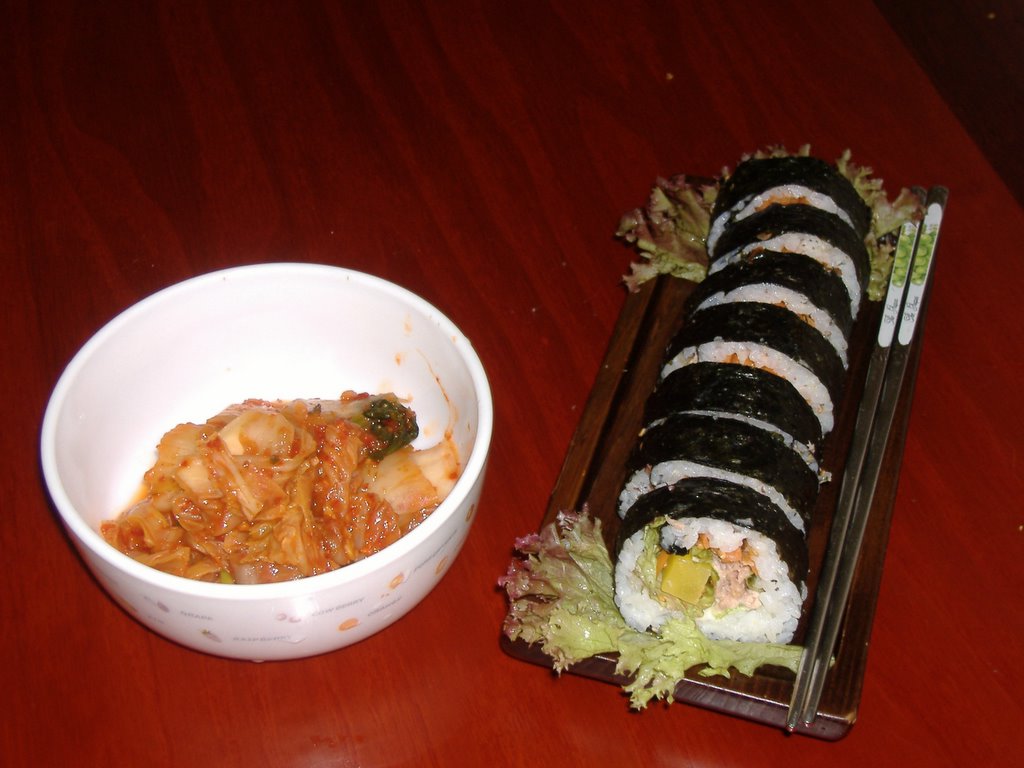
And the kimpap - "Korean sushi" - which is, according to some Koreans I've spoken with, "just like sushi, but much better." (Thanks to my beautiful rice steamer, I've learned to make kimpap that is almost as good as the diner down the street, minus the spam and MSG).

Always she goes on about the rice steamer, but ask her to clean it and find out the truth (like a little kid with a dog, whose parents feed and and walk it). So you get the point right? Koreans are not fond of the Japanese.

Back to first week of teaching ( if I'm allowed).
As I mentioned earlier the hardest thing for me was to move beyond the idea of actually teaching the students and grasp the far more important issue. Make the parents happy. We teach at an English hogwan which put simply is a tutoring academy (there are also science, math, art, music, Korean, phys. ed, and at least a couple other kinds of hogwans). More complexly it is yet another example of the "keeping up with the Kims", a diabolical scheme which drains approximately seven billion dollars annually from the pockets of well intentioned parents (which is more than the Korean government spends on the education system in a year), while at the same time working to undermine that same underfunded public education system. Sound complicated? Think of it this way: if your neighbors send their children to three hogwans then how could send your children to any less... maybe you should send them to four...and the trend continues. The whole while the kids are learning in advance in the hogwans what they learn in the public schools, thus making public education irrelevant.
So here we are, the native English speakers brought to Korea not to teach the children English, but for the hogwan to keep up with other hogwans that also have native English speakers.
Basically I tell them to do their homework - after all, if they don't have homework, the parents aren't getting their money's worth.