Showing posts with label politics. Show all posts

Sunday, February 27, 2011

The Jasmine Road: Will this Revolution Spread to China?

The recent upheavals in the Arab world are changing history in an unprecedented way. Sparked by the self-immolation of Mohamed Bouazizi in Tunisia, the Jasmine Revolution has toppled the governments of Tunisia and Egypt (and, likely sooner than later, Libya). Protests have been occurring in Yemen for weeks now, as the citizens of these Arab states take to the streets to declare that their corrupt rulers no longer have the mandate of the people (if ever they did), and that the people will no longer stand for it. There have been movement and mobilization of people in Bahrain, and there is even a national day of protest on March 11th in Saudi Arabia, where people are seeking "a minimum wage of 10,000 riyals ($2,700), greater employment opportunities, [to] establish a watchdog to eliminate corruption and cancellation of 'unjustified taxes and fees.' Other requests included rebuilding the armed forces, reforming Saudi Arabia's powerful and conservative Sunni Muslim clerics, and "the abolition of all illegal restrictions on women" in the kingdom." And this is coming from a kingdom where unsanctioned public assembly is illegal.

News of the Arab revolutions have spread to China, where they have (unsurprisingly) made the Central Politburo even more watchful than usual, and where coverage of the protests are, of course, heavily censored by the Communist Party. An attempted demonstration last week, launched by "a mysterious call," has put the Chinese government on guard, and when the protesters tried to assemble in central Beijing, they found they were outnumbered by the police. There has, however, been another appeal for gatherings next week in Beijing and 22 other Chinese cities.

Could the revolution spread to China? Personally, I don't think it's as likely, seeing as how the some Chinese are now enjoying some of the highest standards of living they have ever seen, which in turn leaves them more content and secure. In addition, the Chinese population is aging, while the Arab states tend to have a much more youthful, yet disenfranchised demographic. However, the gap between rich and poor in China continues to grow rapidly, and with such a large population, the poor represent a significant amount of the country's people. Here, five experts weigh in with their opinions on the situation particular to China.

Yet, there are some questions that some Chinese people are starting to face with increasing confidence about their rights, especially in regards to basic needs such as housing, employment and food. In the article "Could the Revolution Spread to China?", the author describes a video that was floating around on Chinese webspace around Lunar New Year (the Year of the Rabbit) before all the links to the video were blocked. It describes:
... the opening scene, a small village of rabbits is living happily when a truck selling Three Tiger baby milk pulls up and drops off bottles for all the little bunnies.

But the milk is poisonous – it makes the baby rabbits' heads explode – and soon one mother rabbit is running down to complain at the cave of the tigers (the outgoing lunar year) that rule over them. When she gets inside, the red banner hanging on the cave wall is familiar to anyone who lives in China. “Build a harmonious forest,” it reads, in a clear reference to President Hu Jintao's oft-stated goal of establishing a “harmonious society.”

Though the creator maintained that his video was simply an “adult fairy tale,” the parallels to real life in China were all too obvious. Predictably, all links to the video were blocked within hours of its original appearance.

Is this the year the Chinese people rise up for the first time since 1989, when pro-democracy demonstrations were crushed by tanks on Tiananmen Square? Could the wave of popular protests that began in Tunis and swept through Cairo eventually reach Beijing? Could fast-rising food costs and the leaping price of oil bring an end to the unspoken pact – economic growth in exchange for stability – between the ruling Communist Party and China's 1.3 billion citizens?


Whatever happens in the end, the process of toppling long-held structures and existing regimes is exciting and refreshing, and can be interpreted very optimistically for a lot of people. However, whether or not the Jasmine Revolution eventually picks up steam in China, and whether or not the bunnies grow teeth this year or maybe the next, it has already changed the face of the Middle East forever, and the process is not yet finished. When the dust settles and the new leaders emerge, who will they be, and how will they rule?

Sunday, February 6, 2011

Move Over, Korean Blood Myth

Gasp... choke... could Korea be on the move to a multicultural society? May it start having to redefine its notion of Korean culture, the Korean one-blood myth, its nationalism? There is an interesting demographic shift on the way: one in ten South Korean men and women get married to a foreigner, most of whom are made up of brides from China and Vietnam. My question: when will the "waygooks" who have made Korea their home, indeed who have "mixed-race" children, no longer be known as foreigners, nor be treated in an inferior way to Aryan "pure-blood" Koreans?

Wednesday, February 2, 2011

This is what democracy looks like!

The other day, I did a little discussion activity with my class. We started off by talking about Egypt and what was going on there (thanks, BreakingNewsEnglish, for the pre-made lesson). We brainstormed together about reasons that might cause people to demonstrate in the streets (war, crime, poverty, corruption, etc). We did some vocabulary, some listening, and then I asked them what would cause them to protest, so they talked in small groups for a little bit.

One of my Chinese students, as he was talking, was searching for a word: "what do you say when the government/media tells you one thing, but you know they only give you some information, and some of that information is missing or false?" My response: "censorship." He then proceeded to tell me that the formula for Chinese news, or CCTV, was as follows: one third talks about the Chinese leadership and how hard they've been working, the second third talks about how happy the Chinese people are, and the final third finishes by describing how unhappy the rest of the world is. The other Chinese students generally concurred.

We then talked a little about the history of pro-democracy rallies and demonstrations in their countries. It was a very interesting class because my students are from China (Tiananmen), Korea (Gwangju), and Iraq (need I say more).

I was surprised. Often, when I try to talk about current events in class, the students don't really seem to care, but they were surprisingly engaged and focused.

Monday, November 15, 2010

The Korean Government

I love it when they do this! ... but I really don't understand. From the caption for the last photo: "Observers of Korean politics say the nation's lawmakers would rather fight than switch votes. Says Andy Jackson, a political columnist for the Korea Times, 'The attitude is that if you're not fighting, you're not trying.'"

Saturday, February 18, 2006

Teaching English in Korea 101

Well my first week of teaching has come to a close and as excited as I am to be finished a small voice in my head tells me there are still 51 to go...Oy Veh.

So what is teaching English to Korean children ranging from 8 to 13 like?
What I've realized first off is that to stay sane one has to first and foremost throw out the whole idea of teaching....it implies learning. I'm not saying I don't try to teach, rather the whole system that we're working in is designed to be ineffective - much like Korea.
Seriously, I'm growing to believe that the only way this country "runs" is to be constantly creating new work by never doing the job right the first time. Perhaps the best example is in the construction methods used to build the apartment buildings that cover the landscape. The buildings are designed to be built fast with a life of about 5 years. Korea is not like Japan, that has to build with the awareness that an earthquake will likely destroy their work every few years. Korea has no such problem: perhaps they just have Japan envy.

Probably the second most important thing that I've learned is to never under any circumstances tell a Korean that they have "Japan envy". (Editor's note - at this point, Hanna kicks Matt off the computer). Well, you know there was that whole colonialism thing between 1910 and 1945, when Japan ruled Korea with an iron fist. That, and the numerous invasions from previous centuries when countless temples and relics were destroyed by Japanese invaders. As a result, the Koreans are none too fond of their neighbours to the east. On most world maps, the body of water separating the two countries is called the "Sea of Japan", but here you would never, ever say such a thing. It is simply the East Sea. Now, lying somewhere in this "East Sea" is the small uninhabited island of Dokdo, just a few rocks really. However, these rocks are hotly contested between the two countries, with both claiming sovereignty. Dokdo inspires such incredible, passionate patriotism in the children here, it's quite remarkable. At the very mention of the word, some of my more boisterous students jump up on their chairs and burst into a proud Korean anthem which claims Dokdo as theirs. In a couple classes, we got on the topic of reunification with North Korea, which led to a discussion of the atomic bomb, and inevitably to why Japan ceased its occupation of the Korean peninsula in 1945. "Nuke them again! Nuke them again!" was their shouted response. In another class, I asked them to describe their dream weekend. One 10 year old student's response: Friday - travel to Japan. Saturday - kill the Japanese emperor and dispose of his body. Sunday - return to Korea and think of an alibi.
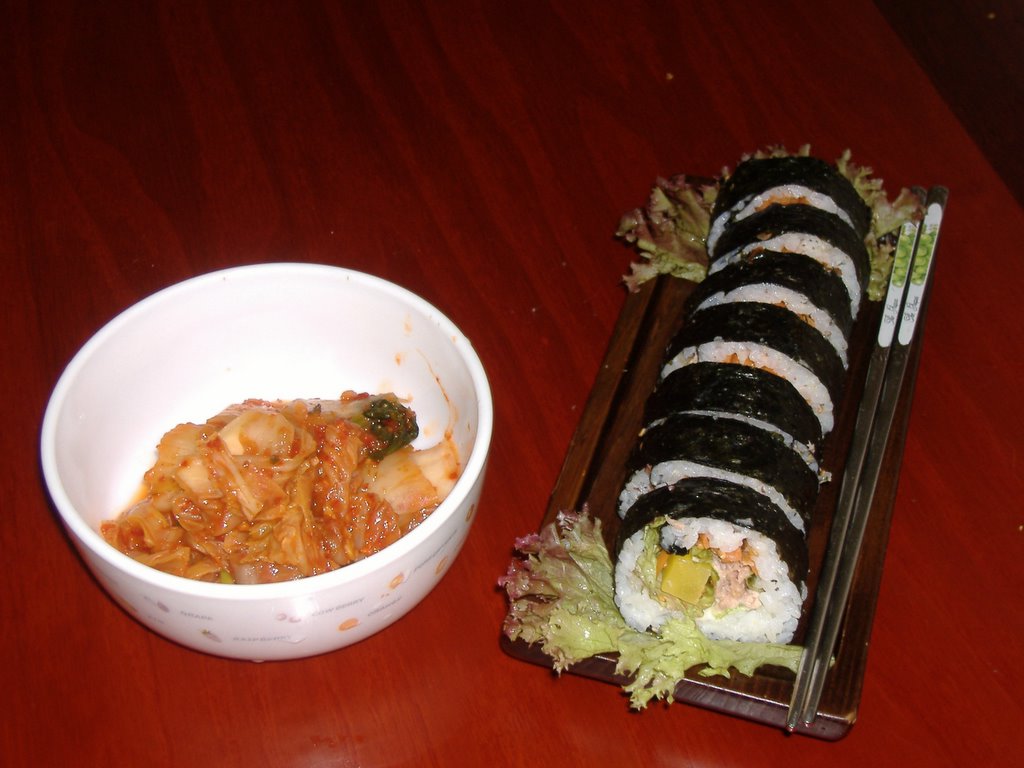
And the kimpap - "Korean sushi" - which is, according to some Koreans I've spoken with, "just like sushi, but much better." (Thanks to my beautiful rice steamer, I've learned to make kimpap that is almost as good as the diner down the street, minus the spam and MSG).

Always she goes on about the rice steamer, but ask her to clean it and find out the truth (like a little kid with a dog, whose parents feed and and walk it). So you get the point right? Koreans are not fond of the Japanese.

Back to first week of teaching ( if I'm allowed).
As I mentioned earlier the hardest thing for me was to move beyond the idea of actually teaching the students and grasp the far more important issue. Make the parents happy. We teach at an English hogwan which put simply is a tutoring academy (there are also science, math, art, music, Korean, phys. ed, and at least a couple other kinds of hogwans). More complexly it is yet another example of the "keeping up with the Kims", a diabolical scheme which drains approximately seven billion dollars annually from the pockets of well intentioned parents (which is more than the Korean government spends on the education system in a year), while at the same time working to undermine that same underfunded public education system. Sound complicated? Think of it this way: if your neighbors send their children to three hogwans then how could send your children to any less... maybe you should send them to four...and the trend continues. The whole while the kids are learning in advance in the hogwans what they learn in the public schools, thus making public education irrelevant.
So here we are, the native English speakers brought to Korea not to teach the children English, but for the hogwan to keep up with other hogwans that also have native English speakers.
Basically I tell them to do their homework - after all, if they don't have homework, the parents aren't getting their money's worth.