Yes, that's right. Today is actually National Grammar Day!!! (Well, it is in the US, at least). It is imperative we raise a glass to gerunds and infinitives, congratulate the conditionals and send a mazel tov to all the main verbs who agree with their subjects. You can read more about National Grammar Day here.
So, in homage to National Grammar Day (which I believe should be International Grammar Day!), enjoy this 'classic' grammar lesson from Monty Python's Life of Brian.
Showing posts with label education. Show all posts
Showing posts with label education. Show all posts
Friday, March 4, 2011

Wednesday, February 2, 2011
This is what democracy looks like!
The other day, I did a little discussion activity with my class. We started off by talking about Egypt and what was going on there (thanks, BreakingNewsEnglish, for the pre-made lesson). We brainstormed together about reasons that might cause people to demonstrate in the streets (war, crime, poverty, corruption, etc). We did some vocabulary, some listening, and then I asked them what would cause them to protest, so they talked in small groups for a little bit.
One of my Chinese students, as he was talking, was searching for a word: "what do you say when the government/media tells you one thing, but you know they only give you some information, and some of that information is missing or false?" My response: "censorship." He then proceeded to tell me that the formula for Chinese news, or CCTV, was as follows: one third talks about the Chinese leadership and how hard they've been working, the second third talks about how happy the Chinese people are, and the final third finishes by describing how unhappy the rest of the world is. The other Chinese students generally concurred.
We then talked a little about the history of pro-democracy rallies and demonstrations in their countries. It was a very interesting class because my students are from China (Tiananmen), Korea (Gwangju), and Iraq (need I say more).
I was surprised. Often, when I try to talk about current events in class, the students don't really seem to care, but they were surprisingly engaged and focused.
One of my Chinese students, as he was talking, was searching for a word: "what do you say when the government/media tells you one thing, but you know they only give you some information, and some of that information is missing or false?" My response: "censorship." He then proceeded to tell me that the formula for Chinese news, or CCTV, was as follows: one third talks about the Chinese leadership and how hard they've been working, the second third talks about how happy the Chinese people are, and the final third finishes by describing how unhappy the rest of the world is. The other Chinese students generally concurred.
We then talked a little about the history of pro-democracy rallies and demonstrations in their countries. It was a very interesting class because my students are from China (Tiananmen), Korea (Gwangju), and Iraq (need I say more).
I was surprised. Often, when I try to talk about current events in class, the students don't really seem to care, but they were surprisingly engaged and focused.
Tuesday, January 25, 2011
Grammar Rules!
I make no qualms to hide the fact that I think English grammar is really interesting, and I think my enthusiasm for it comes across in my teaching. (In fact, I'm the grammar teacher for my level at work... that is, I teach grammar to my own class in addition to two other classes).
Before I taught in Korea, and even after teaching there, I had no idea how to explain anything in regards to grammar. I had no idea about verb tenses, parts of speech, or any formal terms to explain the process and the practice of grammar. After I completed my TESL certification at the U of S, however, I realized halfway through my grammar and phonology class that I am actually one of those people who really get enthused about the underlying structures of the language.
I think that anyone who has struggled with learning a second language has probably sat through innumerable grammar classes with a teacher droning on about irregular verbs or some kind of impossible tense, but I take a different approach. I present the grammar structure we're studying, and have them take notes (so they can also practice their listening/note-taking skills), then I make them explain to each other (in partners) the concept I just taught them. I will then usually do a quick drill or worksheet to reinforce the concept before doing a class activity (role-play, discussion, game, etc) that requires more thought and creativity with the grammatical structure than a simple drill or worksheet.
When I first started teaching at my university, I had very little experience teaching grammar and not a lot of knowledge as to how to teach it. However, my amazing co-worker John, (also a former ESL teacher in Korea), created a handout for a presentation he did at a conference a while back which clearly explains all the verb tenses. Check it out here! (It won't make you tense, I promise).
Before I taught in Korea, and even after teaching there, I had no idea how to explain anything in regards to grammar. I had no idea about verb tenses, parts of speech, or any formal terms to explain the process and the practice of grammar. After I completed my TESL certification at the U of S, however, I realized halfway through my grammar and phonology class that I am actually one of those people who really get enthused about the underlying structures of the language.
I think that anyone who has struggled with learning a second language has probably sat through innumerable grammar classes with a teacher droning on about irregular verbs or some kind of impossible tense, but I take a different approach. I present the grammar structure we're studying, and have them take notes (so they can also practice their listening/note-taking skills), then I make them explain to each other (in partners) the concept I just taught them. I will then usually do a quick drill or worksheet to reinforce the concept before doing a class activity (role-play, discussion, game, etc) that requires more thought and creativity with the grammatical structure than a simple drill or worksheet.
When I first started teaching at my university, I had very little experience teaching grammar and not a lot of knowledge as to how to teach it. However, my amazing co-worker John, (also a former ESL teacher in Korea), created a handout for a presentation he did at a conference a while back which clearly explains all the verb tenses. Check it out here! (It won't make you tense, I promise).
Saturday, February 18, 2006
Teaching English in Korea 101
 Well my first week of teaching has come to a close and as excited as I am to be finished a small voice in my head tells me there are still 51 to go...Oy Veh.
So what is teaching English to Korean children ranging from 8 to 13 like?
What I've realized first off is that to stay sane one has to first and foremost throw out the whole idea of teaching....it implies learning. I'm not saying I don't try to teach, rather the whole system that we're working in is designed to be ineffective - much like Korea.
Seriously, I'm growing to believe that the only way this country "runs" is to be constantly creating new work by never doing the job right the first time. Perhaps the best example is in the construction methods used to build the apartment buildings that cover the landscape. The buildings are designed to be built fast with a life of about 5 years. Korea is not like Japan, that has to build with the awareness that an earthquake will likely destroy their work every few years. Korea has no such problem: perhaps they just have Japan envy.
Probably the second most important thing that I've learned is to never under any circumstances tell a Korean that they have "Japan envy". (Editor's note - at this point, Hanna kicks Matt off the computer). Well, you know there was that whole colonialism thing between 1910 and 1945, when Japan ruled Korea with an iron fist. That, and the numerous invasions from previous centuries when countless temples and relics were destroyed by Japanese invaders. As a result, the Koreans are none too fond of their neighbours to the east. On most world maps, the body of water separating the two countries is called the "Sea of Japan", but here you would never, ever say such a thing. It is simply the East Sea. Now, lying somewhere in this "East Sea" is the small uninhabited island of Dokdo, just a few rocks really. However, these rocks are hotly contested between the two countries, with both claiming sovereignty. Dokdo inspires such incredible, passionate patriotism in the children here, it's quite remarkable. At the very mention of the word, some of my more boisterous students jump up on their chairs and burst into a proud Korean anthem which claims Dokdo as theirs. In a couple classes, we got on the topic of reunification with North Korea, which led to a discussion of the atomic bomb, and inevitably to why Japan ceased its occupation of the Korean peninsula in 1945. "Nuke them again! Nuke them again!" was their shouted response. In another class, I asked them to describe their dream weekend. One 10 year old student's response: Friday - travel to Japan. Saturday - kill the Japanese emperor and dispose of his body. Sunday - return to Korea and think of an alibi.
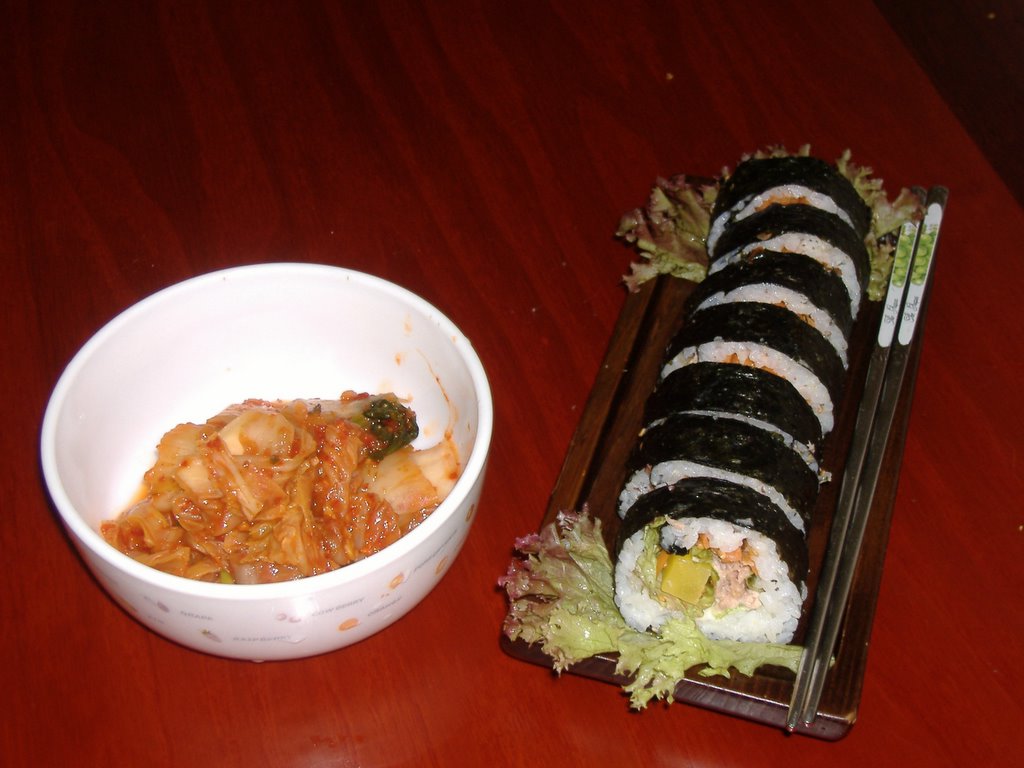
And the kimpap - "Korean sushi" - which is, according to some Koreans I've spoken with, "just like sushi, but much better." (Thanks to my beautiful rice steamer, I've learned to make kimpap that is almost as good as the diner down the street, minus the spam and MSG).
Always she goes on about the rice steamer, but ask her to clean it and find out the truth (like a little kid with a dog, whose parents feed and and walk it). So you get the point right? Koreans are not fond of the Japanese.
Back to first week of teaching ( if I'm allowed).
As I mentioned earlier the hardest thing for me was to move beyond the idea of actually teaching the students and grasp the far more important issue. Make the parents happy. We teach at an English hogwan which put simply is a tutoring academy (there are also science, math, art, music, Korean, phys. ed, and at least a couple other kinds of hogwans). More complexly it is yet another example of the "keeping up with the Kims", a diabolical scheme which drains approximately seven billion dollars annually from the pockets of well intentioned parents (which is more than the Korean government spends on the education system in a year), while at the same time working to undermine that same underfunded public education system. Sound complicated? Think of it this way: if your neighbors send their children to three hogwans then how could send your children to any less... maybe you should send them to four...and the trend continues. The whole while the kids are learning in advance in the hogwans what they learn in the public schools, thus making public education irrelevant.
So here we are, the native English speakers brought to Korea not to teach the children English, but for the hogwan to keep up with other hogwans that also have native English speakers.
Basically I tell them to do their homework - after all, if they don't have homework, the parents aren't getting their money's worth.
Saturday, January 7, 2006
Why A Fine Arts Degree is "Worth It"

Aside from functioning as a very expensive daycare for those fresh out of high school or not so fresh out, I've been racking my brain to think of why a liberal arts degree (or more specifically a Fine Arts degree) is worth the time and money invested.
A couple obvious answers come to mind, like oh say being able to teach English in a foreign country like Korea. Or maybe the knowledge that you have a new perception of the world that your parents and family who haven't taken all the liberal arts classes simply cannot understand.
Maybe your parents have paid for your degree and you don't like them, so there's some satisfaction in knowing how much they've spent for you to go to university for an Art degree and barely graduate.
I'm sure for everyone there is a different answer, and maybe some answers would even include words like career, work or job. Such words seem strange to me but I'm only one person.
For myself the answer may evolve with time (maybe someday career or job won't seem so foreign) but for now it would be that I can draw pictures my son enjoys, pictures that would have earned me no respect if I had drawn them while in university.
Matt
Subscribe to:
Posts (Atom)